|
Barn accidents are often explained away as bad luck or unpredictable horse behavior. In reality, many incidents share a quieter root cause: operational design choices that increase risk long before a horse ever reacts. From aisle layout to lighting and traffic flow, barn environments either support safe decision-making or undermine it.
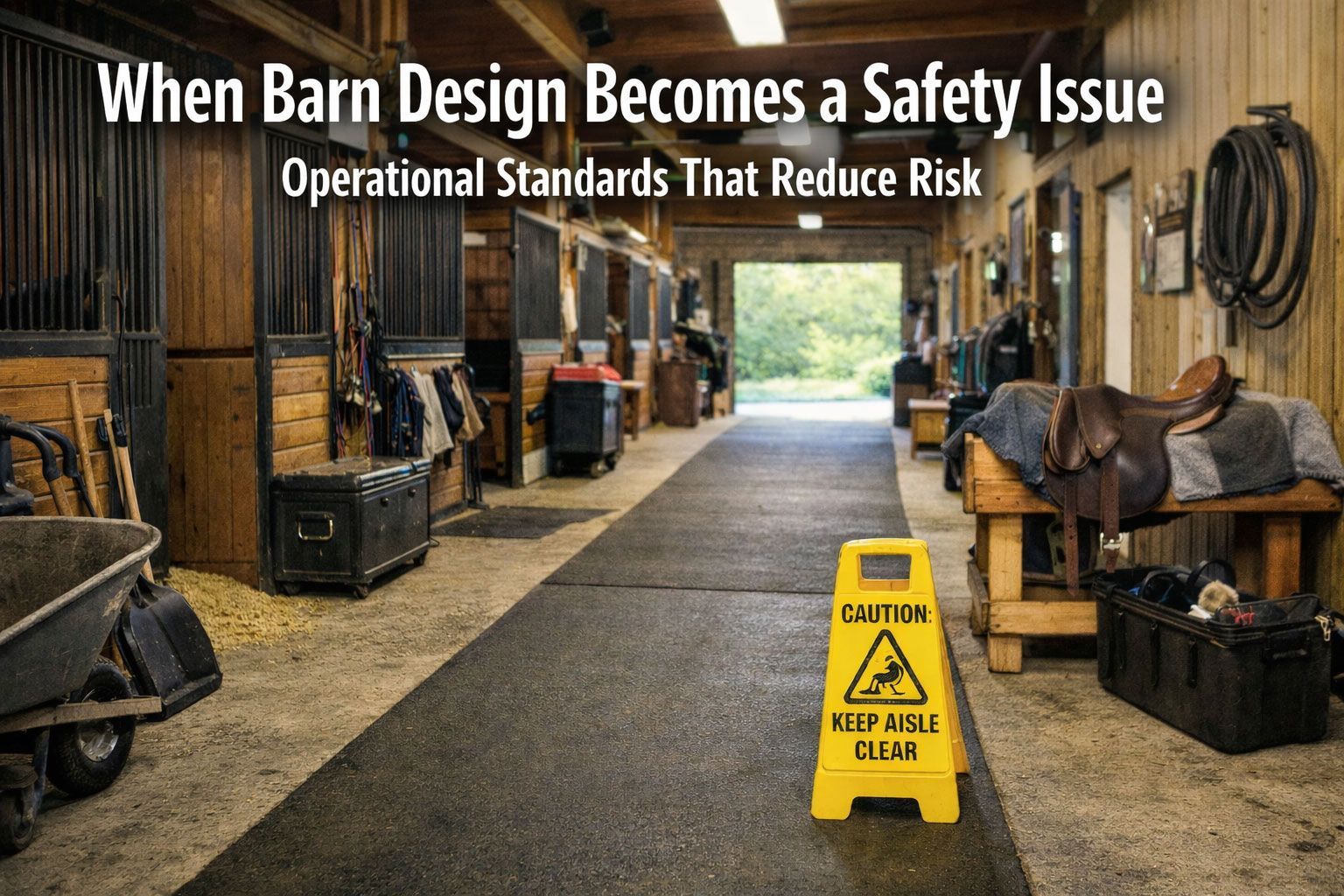
One of the most common failures is informal aisle management. Barn aisles function as shared corridors for horses, people, equipment, and visitors, yet they are frequently treated as flexible storage space. Wheelbarrows parked “temporarily,” tack trunks left open, or hoses stretched across walkways narrow clearance and remove escape options. When horses are forced into tight passages, startle responses escalate and handlers lose margin for error.
Lighting is another underestimated factor. Inconsistent illumination, burned-out fixtures, and sharp contrast between indoor and outdoor spaces impair both human judgment and equine confidence. Horses entering dim aisles from bright daylight often hesitate or spook, while people misjudge footing, distance, or body position. These are not training failures but environmental ones.
Traffic patterns also matter. Many barns lack defined movement protocols, allowing horses to be led in opposing directions through narrow spaces or congregated near stall fronts during peak hours. Visitors unfamiliar with barn flow may stop abruptly in aisles or stand in high-traffic zones. Without clear expectations, even experienced staff are forced to improvise, increasing cognitive load and reaction time.
Effective barns treat safety as an operational system, not a set of reminders. Clear aisle width standards, (10 - 12 feet, with 12 feet being strongly recommended for safety and functionality, allowing easy passage for horses, people, and equipment and 14 to 16 feet being ideal for larger operations or heavier equipment), designated equipment zones, uniform lighting, and predictable traffic flow reduce reliance on constant verbal correction. Visual cues like floor markings or signage and consistent layout do much of the work quietly and reliably.
Importantly, these measures protect more than people. Horses move more calmly through predictable environments. Reduced startle responses mean fewer training setbacks, fewer injuries, and more consistent handling outcomes. Safety standards are not restrictive; they are enabling.
Barn owners and managers who adopt a systems-based approach often report fewer near-misses within weeks, not years. The changes are rarely dramatic. They are disciplined, repeatable, and enforced without exception. In an industry that prides itself on horsemanship, it is worth remembering that good environments support good behavior - on both sides of the lead rope.
Tanja Schnuderl is a trusted barn management & horse behavior authority, serving as Senior Equine Appraiser and Director of International Services with The Equine Expert LLC, a multi-discipline equine expert witness and consulting firm. With extensive experience managing boarding, training, breeding and show facilities, she brings a practical understanding of how day-to-day operations impact both horse welfare and legal outcomes. Through her work with clients and attorneys nationwide, she helps bridge the gap between the barn aisle and the courtroom. Learn more at www.theequineexpert.com or reach out via email to [email protected].
|